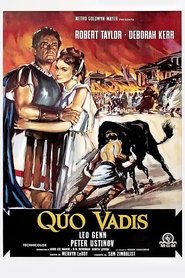
Quo Vadis

Titolo originale: Quo Vadis
Regia: Mervyn LeRoy |
Anno: 1951
Origine: United States of America |
Generi: Dramma Storia Romance
Tag: epic | suicide | based on novel or book | rome, italy | roman empire | christianity | emperor | ancient rome | burning | roman army | nero | 1st century | christian film | claudius caesar | guarda pretoriana | praetorian guard | matricídio | sêneca |
Cast: Robert Taylor | Deborah Kerr | Leo Genn | Peter Ustinov | Patricia Laffan | Finlay Currie | Abraham Sofaer | Marina Berti | Buddy Baer | Felix Aylmer | Nora Swinburne | Ralph Truman | Norman Wooland | Peter Miles | Geoffrey Dunn | Nicholas Hannen | D.A. Clarke-Smith | Rosalie Crutchley | John Ruddock | Arthur Walge | Elspeth March | Strelsa Brown | Alfredo Varelli | Roberto Ottaviano | William Tubbs | Pietro Tordi | Marika Aba | Adriano Ambrogi | Anna Arena | Alfred Baillou | Giacomo Barnas | Scott R. Beal | John Binns | Francesca Biondi | Carlo Borelli | Leslie Bradley | Alfred Brown | Valentino Bruchi | Dante Ciriaci | Frank Colson | Adrienne Corri | Luca Cortese | David Craig | Daniel de Jonghe | Liana Del Balzo | Jack Del Rio | Lia Di Leo | Franco Fantasia | Cesare Fasulo | Al Ferguson | Enzo Fiermonte | Enrico Formichi | John Fostini | Dino Galvani | Richard Garrick | Jack George | Carlo Ghisini | Trudy Glassford | Joan Griffiths | Robin Hughes | Adam Jennette | Philip Kieffer | Gipsy Kiss | Lee Kresel | Richard Larke | Sophia Loren | Giovanni Lovatelli | Helena Makowska | Anna Mancini | Michael Mark | Clelia Matania | Richard McNamara | Harriet Medin | Dario Michaelis | Ernesto Molinari | John Myhers | Vincent Neptune | Anna Maria Padoan | Louis Payne | Walter Pidgeon | Aldo Pini | Alberto Plebani | Paola Quattrini | Dino Raffaelli | George Restivo | Alfredo Rizzo | Amerigo Santarelli | Leonardo Scavino | Alessandro Serbaroli | Bud Spencer | Raffaele Tana | Elizabeth Taylor | William Taylor | Michael Tor | Giuseppe Tosi | Carlo Tricoli | Renato Valente | Scilla Vannucci | Giuseppe Varni | Dianora Veiga | Harry J. Vejar | Romilda Villani | Maria Zanoli | Christopher Lee | Filippo Spoletini |

Siamo a Roma nel 64 d.C. sotto l'Imperatore Nerone (Peter Ustinov), tra finzione e realtà storica. Protagonisti sono il comandante romano, Marco Vinicio (Robert Taylor), e la cristiana Lycia (Deborah Kerr). I due sono innamorati ma per loro i tempi sono difficili, è fortissima la persecuzione dei cristiani e Marco per averla deve chiederla in premio, come schiava, per i suoi meriti in battaglia. L'Imperatore sempre più folle brucia la città e accusa i cristiani condannandoli ad una uccisione di massa nell'arena del Colosseo.

Approfondimenti

Despite the happy ending to the film, the reign of Nero's successor Galba was a short-lived disaster [...] D
Mervyn Le Roy told that during the one year of shooting in Italy, he lost more than twenty two pound [...] D
Uncredited American movie debut of Bud Spencer (Imperial Guard). He had an equally uncredited part i [...] D
Professional wrestler Buddy Baer (Ursus) was the brother of former heavyweight boxing champion Max B [...] D
Stewart Granger actively sought the lead role, but was unwilling to commit to a long-term contract w [...] D
Over 30,000 extras appeared. D
Elizabeth Taylor asked a favor to Mervyn Le Roy, she asked him to hid her for a while from her husba [...] D
Legendary character actor Finlay Currie had prominent roles in this film as well as the classic roma [...] D
Director Mervyn LeRoy (who himself was Jewish) had a private meeting with Pope Pius XII and asked hi [...] D
Sophia Loren (age 15 when the film was made in 1950) has an uncredited, but easily spotted, bit part [...] D
The top-grossing U.S. movie of 1951. D
Miklós Rózsa used Galba's March that he composed for the conclusion of this movie in Ben-Hur ( [...] D
Lia Di Leo's debut. D
Amongst the many actresses who tried out for a role in this movie was a pre-stardom Audrey Hepburn. D
Submitted to the British Board of Film Censors on 22 January 1952 and passed with an "X" certificate [...] D
According to director Mervyn Leroy, 60,000 extras were featured in the arena scene. D
Emperor Nero (Sir Peter Ustinov) remarks on the idea of creating an experience in order to gain insp [...] D
This film grossed $21 million at the box office in 1951, equivalent to approximately $210,000,000 in [...] D
In his memoirs, "Dear Me" (1981), Sir Peter Ustinov recalled that MGM had sought him for the role of [...] D
Robert Taylor and Deborah Kerr were considered too old for their characters. Taylor was only six yea [...] D
Filmed at sprawling Cinecitta Studios that had been opened by Benito Mussolini in 1924 as part of th [...] D
This film, The Sign of the Cross (1932), and The Last Days of Pompeii (1935) all feature heroes name [...] D
During the parade, a slave holds a golden crown of olive leaves above Marcus Vinicius' (Robert Taylo [...] D
The ending scripture is John 14:6 "I am the way, the truth and the life..." D
The movie's huge box-office success was credited with saving MGM from bankruptcy. D
Ten handcarved chariots were made especially for this movie. D
Turner Classic Movies stated that in the John Huston biography, Huston wanted Ava Gardner for Lygia, [...] D
Despite being initially thrilled to be directing a Biblical epic, director Mervyn LeRoy found Henryk [...] D
After World War II Robert Taylor had worked on a series of relatively insignificant films until "Quo [...] D
Cinecitta Studios simply didn't have enough electrical power to cope with the demands of lighting su [...] D
The production starved the lions for two weeks before the arena sequences, so that they become more [...] D
Lygia (Deborah Kerr) and Ursus (Buddy Baer) are from ancient Poland, which was called "Lygia" by the [...] D
In this movie, the main character's name, "Vinicius", is correctly pronounced with a hard "c", inste [...] D
Robert Taylor's chest reportedly had to be shaved for his part because the studio feared its hairine [...] D
His work as an assistant was the first opportunity for Sergio Leone to work with Americans. He claim [...] D
The movie used 32,000 costumes. D
Sir Peter Ustinov later said that director Mervyn LeRoy gave him the perfect insight as to how to pl [...] D
Mervyn LeRoy said in his autobiography that he based the staging of the the Roman conflagration spec [...] D
John Huston was the original director, under the supervision of producer Arthur Hornblow, with a cas [...] D
There are 110 speaking parts in this movie. D
Clark Gable turned down the role of Marcus Vinicius, because he thought the costume would make him l [...] D
One immediate problem encountered with the lions was that when they were released from their cages, [...] D
This movie does not cover the death of Paul, although he is acknowledged to have been martyred in 67 [...] D
Robert Taylor and Dame Elizabeth Taylor appeared in Conspirator (1949) and Ivanhoe (1952). D
Nero says when given the dagger, "Is this the end of Nero?" References the movie Little Caesar with [...] D
Marcus is shown taking his bath in a fairly accurate way. Romans did not have soap - a thing that, a [...] D
True to his reputation as a voluptuary, the real Petronius took a week to kill himself by allowing h [...] D
Communists called for a boycott of the film in France and Italy, because Robert Taylor had named nam [...] D
The cast includes two Academy Award winners: Sir Peter Ustinov and Dame Elizabeth Taylor; and two Ac [...] D
The set for the arena was so large and full of commotion among the extras that director Mervyn LeRoy [...] D
Elizabeth Taylor: a Christian prisoner in the arena. D
Appearing in the film is Francesco Quinn the son of Anthony Quinn and Marie Therese Rhen the daughte [...] D
Janet Leigh was considered for the role of Lygia. D
Announcements by the MGM publicity department ranged from: "In making this film, MGM feel privileged [...] D
The narrator is an uncredited Walter Pidgeon. D
Featured Leo Genn's only Oscar-nominated performance. D
Included among the American Film Institute's 2005 list of 250 movies nominated for AFI's 100 Years o [...] D
Sophia Loren's mother, Romilda Villani, also got a bit part as a slave girl. D
Howard Koch was at first supposed to be assistant director, but under the condition that his wife wa [...] D
Kathleen Byron was considered for the role of Lygia. D
Buddy Baer's character is named "Ursus". "Ursus" is Latin for "bear". D
In the novel, Lygia's hair is dark or black, depending on the translation. In the film, she has red [...] D
MGM first began planning to make this film as far back as 1939. At the time, Robert Taylor was annou [...] D
Chilo was a much more important villain in the novel. He inspired Nero to blame the Christians for t [...] D
Included among the American Film Institute's 2002 list of 400 movies nominated for the top 100 top 1 [...] D
Robert Taylor was very reluctant to play the role of Marcus Vinicius because he wasn't keen on weari [...] D
Claude Rains and Fredric March were considered for the part of Petronius. D
The purple tunic Nero wears indicates his noble status. The dye that produced this hue was derived f [...] D
This movie represented a hollow victory for MGM studio chief Louis B. Mayer, since it turned out to [...] D
This movie made its debut on network television after having been shown for several years on local t [...] D
Petronius is credited with writing the satirical "Satyricon". D
The property "Quo Vadis" was being developed by producer Arthur Hornblow in the 1940s. A September 7 [...] D
Amongst the stars considered for roles in this movie were Orson Welles, Marlene Dietrich as Poppaea, [...] D
"Quo vadis" is a Latin phrase meaning "Where are you going?" This was the inscription on a building [...] D
Composer Miklós Rózsa worked hard to achieve an authentic musical score. He incorporated sever [...] D
At the start of the movie the soldier gives a straight arm salute to Taylor. The salute was the Roma [...] D
The movie cost twelve millions dollars and grossed more than fifty millions up to 1974. D
Patricia Laffan (Pappaea) once said in an interview that while reclining on a divan next to a couple [...] D
Robert Taylor was originally cast as Marcus when MGM intended to make the film in the 1930s, but the [...] D
Originally cast in 1949, with Dame Elizabeth Taylor as Lygia, and Gregory Peck as Marcus Vinicius. W [...] D
Re-released by MGM in 1964 to pad its 40th anniversary schedule. D

Connessioni

Nessun dato in archivio

Domande

Nessun dato in archivio

Errori

Throughout the picture, characters claim Jesus opposed slavery. Jesus did not oppose the institution [...] D
Chess was unknown in Europe until at least the seventh century, yet we see soldiers playing. D
When Ursus and the bull are facing each other, the bull's shadow alternates from one side to the oth [...] D
Most courtiers and basically everyone around Nero addresses him as "Divinity". This is not correct, [...] D
In a conversation between Marcus and Petronius, side shots show Petronius' arms in his lap, whereas [...] D
The fire in Rome seems to be near the Emperor's palace, yet when Marcus rushes out to try to save Ly [...] D
Vinicius is described as both a victorious Military Commander and a Military Tribune. In fact, a Mil [...] D
Several lyres and classical harps are seen, but the dubbed soundtrack uses the contemporary pedal ha [...] D
While Robert Taylor is making his speech in the arena, the dead bull is now missing. D
The scene where Nero is on the balcony and soldiers are trumpeting, a modern water tower is shown th [...] D
(at around 1h 6 mins) When Marcus Vinicius is talking to the old Greek man Chilo, Chilo has metal fi [...] D
The lions are attacking obvious dummies in several frames. D
At the time of Nero, the Vatican was home to a circus, not an apocalyptic cesspit as portrayed in th [...] D
Marcus Vinicius is angry because the Emperor will not allow him to bring his legion into the city of [...] D
Roman soldiers did not wear their armor off-duty in social situations. D
In the opening shots of the film, as the camera rises above the march towards Rome, we briefly see t [...] D
(around 2 hours, 8 mins) When Petronius and Eunice are reclining at the dinner table, there is a dec [...] D
Obvious "blue spill" on characters in several scenes, revealing the use of the blue screen process t [...] D
As Petronius is committing suicide, one of his friends lays his head down on the table in grief. Fro [...] D
Marcus Vinicius is awarded a triumph (military parade) in honor of his military victories. By the ti [...] D
In the movie, Petronius commits suicide in AD 64 in the wake of the burning of Rome. In fact, Petron [...] D
(at around 2h 40 mins) When Nero runs from the arena to his apartments inside the palace, it's sunny [...] D
When Nero plays his lyre as Rome burns, the seams and stitching of the night "sky" behind him are cl [...] D
In the scene of Vinicius' triumph, the parade route is going in the wrong direction, marching along [...] D
When Nero holds out his arm to recognize Marcus' triumph, his arm is obviously straight, but in the [...] D
Both the main city backdrops of Rome AND the model of Nero's planned New Rome (or "Neropolis") show [...] D
At the beginning of the film at the head of the marching army are several standard bearers carrying [...] D
Nero, in fact, died four years later in history than shown in the film. However, the events surround [...] D
At the beginning of the film, Marcus Vinicius arrives outside Rome at the head of the 14th Legion, r [...] D
Whilst the arena where the Christian executions take place has an elaborate ornament at its center, [...] D
When the lions are first seen emerging from the cage onto the field, it's possible to see through th [...] D
Though it is much debated, the cross may not have been used as a Christian symbol until the second c [...] D
At the start of the film two generals are seen arriving in Rome by chariot, but the Roman army of th [...] D
The Colosseum, where the climax takes place, was built after Nero's death. In fact, his successor ha [...] D
Lygia notices a big sword after Ursus' big fight with the two attackers. Romans used short swords an [...] D
Bananas were unknown to the ancient Romans, yet they appear in a fruit bowl in Nero's palace. D
When Lygia calls out to Marcus during the burning of Rome, her lips do not move. D
When Nero shows off his model of the new Rome, Petronius asks "But what of the Rome that has stood f [...] D
Whilst it is true that variants of chess have existed for over 2,000 years, the chess set being used [...] D

Frase

Vinicius: I know nothing of politics. Just as long [...] D
Emperor Nero: [as Vinicius and the other soldiers [...] D
Lygia: But, Marcus, don't you see? Unless you try [...] D
Emperor Nero: Yet there are those who say that I a [...] D
Emperor Nero: I didn't wish to be a monster. The g [...] D
Lygia: Ten big, strong Praetorian Guards to suppor [...] D
Petronius: It is not enough to live well. One must [...] D
Emperor Nero: Dear Poppaea, one woman should never [...] D
Emperor Nero: Is it possible that human beings can [...] D
Emperor Nero: [as the Christians enter the arena t [...] D
Vinicius: [as the Christians file into the arena, [...] D
Emperor Nero: [about the angry roman mob] Petroniu [...] D
Emperor Nero: Poppaea, one woman shouldn't judge a [...] D
Vinicius: [speaking of Nero] His new wife, Poppea, [...] D
Lygia: [to Vinicius, after he has been revived fol [...] D
Vinicius: There's such an army of gods these days [...] D
Vinicius: [Seeing the mighty Ursus for the first t [...] D
Tigellinus: Rome is a sea of flames. It burns from [...] D
Poppaea: [as Marcus enters] As usual your entrance [...] D
Petronius: [talking to Marcus Vinicius about the s [...] D
[Nero is exasperated with the mobs] Emperor Nero: [...] D
[on being told the Christians are being blamed for [...] D
Vinicius: [when asked how his army defeated the Ga [...] D
Vinicius: And as for the women of Gaul... well, th [...] D
Emperor Nero: They demand too much. I tell you, th [...] D
Petronius: Yesterday, I could have gone to the mob [...] D
Emperor Nero: [to Acte] I command you to stop lovi [...] D
Emperor Nero: [dying] Oh, how dull, how tasteless [...] D
Emperor Nero: [On learning that Petronius is dead] [...] D
Poppaea: It is foolish to kill those you hate, bec [...] D
Petronius: But what of the Rome that has stood for [...] D
Petronius: [to Nero] A genius, Divinity, should ho [...] D
Vinicius: [to Lygia about Paul] That beggar-faced [...] D
Emperor Nero: [none of his closest men will die fo [...] D
Flavius: Hail, Marcus Vinicius, in the name of the [...] D
Guard: The man called Peter has been heard to prea [...] D
Narrator: This is the Appian Way, the most famous [...] D
Emperor Nero: [During the burning of Rome] What do [...] D
Petronius: [to Eunice] You ask why I do this. Beca [...] D
Emperor Nero: I do not ask favors, I confer them. D
Emperor Nero: Is it not disgusting when common bov [...] D
Emperor Nero: It's lonely to be an emperor. D
Acte: You've lived like a monster, now die like an [...] D
Petronius: [after seeing Rome consumed by flames] [...] D
Petronius: Rome has given the world justice and or [...] D
Emperor Nero: [annoyed] Why do you stare at me, Ac [...] D
Petronius: [to Nero] You will be worthy of the spe [...] D
Petronius: [in his dying letter to Nero] To Nero, [...] D
Petronius: [Nero begins to sing again, and his voi [...] D
Petronius: Marcus, I've recently purchased several [...] D
Vinicius: I don't know a great deal about philosop [...] D

Elenchi

Nessun dato in archivio

Community

Visto da

Nessun dato in archivio

Da vedere per

Nessun dato in archivio

Seguito da

Nessun dato in archivio